Investing is not primarily a numbers problem.
It is a behavior problem.
Most investors do not fail because they lack access to information. They fail because they cannot control their emotional responses to volatility, uncertainty, and social pressure.
Markets amplify human psychology:
- Bull markets inflate greed.
- Bear markets magnify fear.
- Volatility triggers panic.
- Social proof fuels herd behavior.
If you do not build a psychological framework, your portfolio will eventually reflect your emotional weaknesses.
This guide will walk you through:
- The science of emotional investing
- The most destructive behavioral biases
- Real-world investor failure patterns
- A practical emotional control system
- A repeatable decision-making framework
- Long-term wealth discipline principles
What Is Emotional Investing?
Emotional investing occurs when decisions are driven by feelings rather than structured analysis.
Common emotional triggers:
- Fear of loss
- Greed for quick gains
- Regret
- Overconfidence
- Social pressure
- Panic during downturns
- Euphoria during rallies
Behavioral finance research consistently shows that individual investors underperform market benchmarks largely due to poor timing decisions driven by emotion.
The paradox:
Most investors know they should “buy low and sell high.”
Emotion makes them do the opposite.
Why Fear and Greed Dominate Financial Markets
Markets are systems driven by human participants. Human psychology has not evolved for probabilistic thinking under uncertainty.
Two primal forces dominate:
1. Fear
Fear is survival-based. In markets it manifests as:
- Selling during corrections
- Avoiding risk entirely
- Overreacting to news
- Exiting positions prematurely
Fear intensifies during:
- Market crashes
- Negative media cycles
- Sudden volatility spikes
2. Greed
Greed is reward-seeking behavior.
In markets it appears as:
- Chasing speculative rallies
- Leveraging excessively
- Ignoring risk management
- Overconcentrating positions
Fear and greed form the emotional cycle of markets.
Without discipline, investors oscillate between these extremes.
The 10 Most Destructive Behavioral Biases in Investing
Understanding bias is the first step toward neutralizing it.
1. Loss Aversion
Investors feel the pain of losses more intensely than the pleasure of gains.
This leads to:
- Holding losing stocks too long
- Refusing to sell poor investments
- Avoiding necessary portfolio rebalancing
Correction Strategy:
- Predefine risk limits
- Set exit rules before entry
- Evaluate positions objectively
2. Herd Mentality
Humans feel safer following the crowd.
When markets rally:
“It must be safe.”
When markets fall:
“Everyone is selling. I should too.”
History shows that herd behavior fuels bubbles and crashes.
Correction Strategy:
- Evaluate fundamentals independently
- Avoid decisions based solely on popularity
- Use valuation frameworks
3. Overconfidence Bias
After a streak of successful trades, investors often:
- Increase position sizes
- Take excessive risks
- Abandon diversification
Correction Strategy:
- Risk fixed percentage per position
- Review performance statistically
- Separate skill from luck
4. Recency Bias
Investors assume recent trends will continue indefinitely.
Correction Strategy:
- Analyze long-term market cycles
- Use historical data
- Avoid extrapolating short-term movements
5. Confirmation Bias
Seeking information that validates existing beliefs while ignoring contradictory evidence.
Correction Strategy:
- Actively seek opposing viewpoints
- Perform “thesis stress tests”
- Define invalidation conditions
6. Anchoring Bias
Investors anchor to purchase price.
“I bought at $100. I’ll wait until it returns.”
Markets do not respect emotional anchors.
Correction Strategy:
- Focus on forward-looking probability
- Evaluate opportunity cost
7. FOMO (Fear of Missing Out)
Chasing rapid rallies without analysis.
Correction Strategy:
- Define entry criteria
- Avoid vertical price spikes
- Follow system signals only
8. Regret Aversion
Avoiding decisions to prevent emotional discomfort.
Correction Strategy:
- Accept uncertainty
- Focus on process quality
9. Availability Bias
Overweighting recent news events.
Correction Strategy:
- Filter noise
- Review macro data calmly
10. Status Quo Bias
Avoiding portfolio adjustments due to inertia.
Correction Strategy:
- Schedule periodic portfolio reviews
- Rebalance systematically
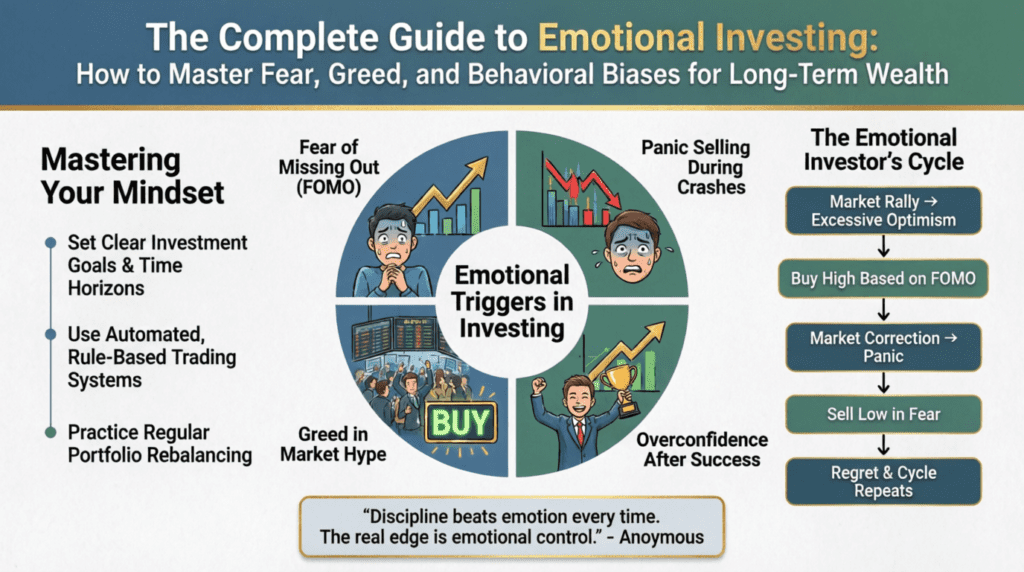
Real-World Pattern: How Emotional Investors Lose Money
Typical sequence:
- Market rises steadily.
- Investor watches from sidelines.
- Media coverage intensifies.
- Investor buys near peak.
- Market corrects sharply.
- Fear takes control.
- Investor sells at loss.
- Market recovers.
- Investor re-enters too late.
Repeat.
Without structure, this cycle becomes chronic.
The Emotional Discipline Framework
To master emotional investing, build systems that override impulse.
Step 1: Create a Written Investment Policy Statement (IPS)
Define:
- Target asset allocation
- Risk tolerance
- Maximum drawdown tolerance
- Rebalancing rules
- Position sizing limits
- Entry and exit criteria
If it is not written, it will change under pressure.
Step 2: Implement Risk Management Rules
Examples:
- Maximum 2% capital risk per trade
- Diversification across sectors
- Stop-loss or thesis-based exit
Risk management reduces emotional intensity.
Step 3: Develop a Decision Checklist
Before entering any investment, ask:
- What is the thesis?
- What invalidates it?
- What is the downside risk?
- What is expected return?
- Is this aligned with my allocation?
Checklists reduce impulsive decisions.
Step 4: Keep a Trading or Investment Journal
Track:
- Entry reasoning
- Emotional state
- Outcome
- Rule adherence
Over time, patterns of bias become visible.
Step 5: Automate Where Possible
Automation reduces emotion:
- Systematic contributions
- Scheduled rebalancing
- Rule-based exits
Long-Term Investing vs Emotional Trading
Investors who succeed over decades:
- Accept volatility
- Avoid market timing
- Rebalance systematically
- Focus on fundamentals
- Maintain diversification
Emotional traders:
- React to headlines
- Overtrade
- Chase trends
- Abandon plans during downturns
Wealth accumulation requires stability, not excitement.
The Role of E-E-A-T in Personal Investing
For finance content and strategy credibility:
- Use data-backed insights
- Reference academic research
- Cite credible sources
- Demonstrate real-world understanding
- Avoid sensational claims
Investors must separate structured analysis from emotional narratives.
Building Psychological Resilience During Market Crashes
During downturns:
- Review long-term allocation
- Reassess fundamentals
- Avoid checking portfolio excessively
- Stick to predefined plan
- Consider strategic rebalancing
Corrections are part of market structure, not anomalies.
The Compounding Advantage of Emotional Discipline
If two investors earn identical average returns but:
Investor A:
- Panic sells occasionally
- Misses recoveries
Investor B:
- Maintains discipline
- Rebalances strategically
Investor B compounds wealth significantly faster over decades.
Small behavioral mistakes have exponential impact over time.
Frequently Asked Questions
What is emotional investing?
Emotional investing refers to making financial decisions based on feelings such as fear or greed rather than structured analysis.
Why do investors underperform the market?
Because of poor timing decisions driven by behavioral biases, especially during volatility.
How can I control fear during market crashes?
By having predefined rules, diversified allocation, and focusing on long-term strategy rather than short-term price movements.
Is it possible to eliminate emotion completely?
No. The goal is not elimination — it is structured management.
Final Thoughts: Your Edge Is Psychological
In modern markets:
- Information is abundant.
- Tools are accessible.
- Strategies are widely known.
What differentiates long-term successful investors is emotional discipline.
Mastering fear and greed does not guarantee market-beating returns.
But failing to manage them guarantees underperformance.
Build systems.
Follow rules.
Control risk.
Think long term.
That is how wealth compounds.